
Mighty Mule Gate Repair in Mira Mesa: A Homeowner’s Guide
Mighty Mule gate repair in Mira Mesa usually means fixing a system that was installed wrong from day one, not a motor that wore out. The operator itself rarely fails first. What fails is the bracket angle, the undersized solar panel, or a battery that was never matched to the gate’s actual draw. If you’re hearing a grind, a click, or nothing at all, the fix usually costs less than you think, and it starts with knowing which failure you actually have. If you’d rather not diagnose it yourself, call (833) 593-4660 and we’ll sort it out.
Why Mighty Mule Gates Fail in Mira Mesa the Way They Do
Mighty Mule’s own warranty data points to bracket misalignment during installation as the leading cause of premature arm wear. Read that again: the motor isn’t the weak point. The install is. A gate that “broke” at year two usually failed at hour one of the original job, and it just took that long for the damage to become loud enough to notice.
In Mira Mesa, we see this pattern constantly. The neighborhood’s single-family driveways are full of FM500s, FM502s, and the older FM231s, and a huge share of them were mounted on a Saturday afternoon by the homeowner with a drill and a YouTube video. That’s not a knock on the homeowner. Mighty Mule markets itself as a DIY-friendly line, and it genuinely is. But DIY-friendly doesn’t mean mistake-proof, and the three most common install mistakes all produce the same symptom a year or two later: a gate that moves slower than it should, grinds when it moves, or stops moving entirely mid-cycle.
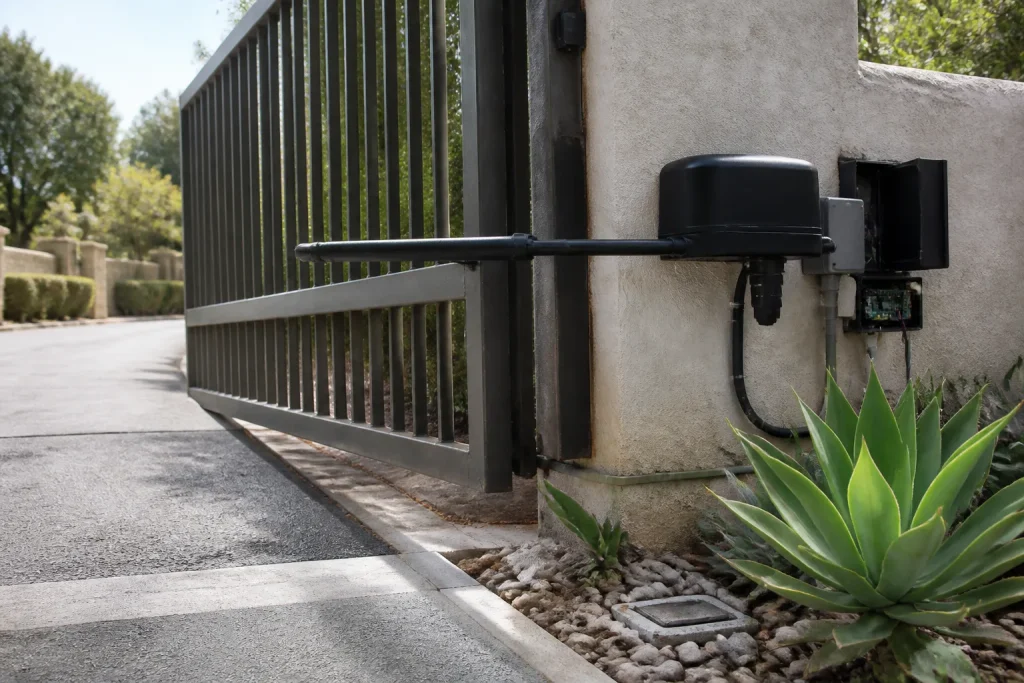
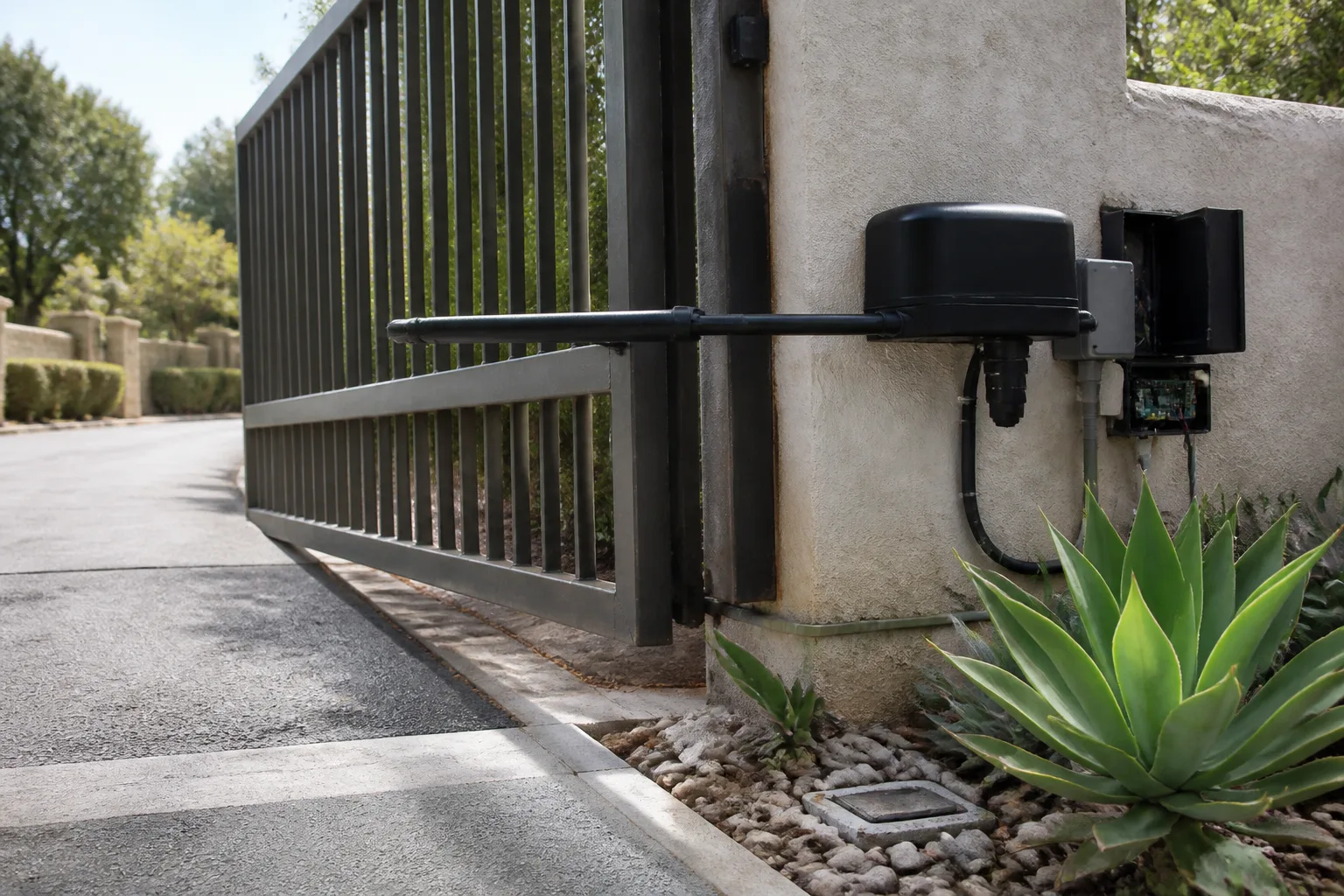
The first mistake is bracket angle. If the opener bracket isn’t mounted perfectly parallel to the gate’s swing plane, the actuator arm binds on every stroke. It still moves at first, because the motor has enough torque to muscle through the bind. But every cycle shaves life off the internal gears. The second mistake is solar panel placement. A panel tucked under an eave or facing the wrong way in Mira Mesa’s specific sun path under-delivers, and the control board compensates by running the battery down further each day. The third is battery selection. A cheap sealed lead-acid battery that doesn’t match the operator’s draw will sag under load, which cooks the control board over time.
So when someone calls us about a “broken” Mighty Mule in Mira Mesa, our first question isn’t “What’s it doing?” It’s “When was it installed, and by who?” Because the answer usually tells us exactly where to look before we even open the cover.
The Three Mighty Mule Models You’ll See on Mira Mesa Driveways
Not every Mighty Mule fails the same way. The model matters, because the failure modes are different enough that a repair quote for one can be triple the quote for another. Here’s what we see most often in Mira Mesa:
- FM500: The most common residential unit on single-width driveways. The arm and gearbox are workhorses, but the control board is picky about voltage. If the battery sags or the solar panel under-delivers, the board starts throwing false obstruction faults. The gate will reverse halfway through a cycle for no visible reason. Most FM500 “faults” are actually power problems, not board failures.
- FM502: This is the dual-gate version, and it’s where bracket misalignment does the most damage. Both arms have to be mounted at identical angles, and if one is off by even a few degrees, the two gates fight each other through the controller. The symptom is usually one gate moving slower than the other, then one motor burning out while the other looks fine.
- FM231: The older workhorse that’s been on Mira Mesa driveways for a decade or more. Solid unit, but parts are getting harder to source, and the original control boards are now aging out. When an FM231 goes down, the question is less “what failed” and more “is it worth repairing, or is this the moment to upgrade?”
We work on the brand already on your property, no replacement required just because a competitor doesn’t recognize the name. But with the FM231 specifically, there’s a real conversation to have about repair economics, and we’ll get to that below.
Clicking or Grinding: Diagnosing the Real Problem
Here’s a scenario we hear at least twice a week from Mira Mesa homeowners: the gate clicks, or it grinds, or it groans, and someone tells them the motor is shot and they need a full replacement. Sometimes that’s true. Usually it isn’t.
A clicking sound when you trigger the opener almost always means the control board is sending power but the actuator isn’t engaging. That’s an electrical delivery problem, not a mechanical one. The usual culprits are a battery that’s dropped below minimum voltage, a corroded connection at the battery terminal, or a control board relay that’s finally quit. None of those require replacing the arm.
A grinding sound while the gate moves is the opposite: the motor is running and the gears are turning, but something in the mechanical path is resisting. That’s usually the pivot bracket seizing, the actuator arm binding against a misaligned mount, or the internal gearbox eating itself. The first two are bracket problems and cost a couple hundred dollars to correct. The third is a motor problem and costs more.
The diagnostic fork is simple: if it clicks but doesn’t move, check the power side first. If it moves but sounds awful, check the mechanical side. A seized pivot bracket on a Mira Mesa gate is often just rust and accumulated grit; we’ve freed brackets that looked like they were done for with penetrating oil and a proper realignment. The price difference between that repair and a new actuator is significant, so it’s worth getting someone who can tell the difference before you approve a replacement.
When should you stop poking at it and call a pro? When you’ve confirmed the battery has a full charge and the gate still won’t respond, or when the arm is physically binding and you’d have to force it to move. A Mighty Mule actuator is under real spring tension, and a bracket failure can release stored energy. That’s the moment to call (833) 593-4660 rather than keep cranking on it.
Mira Mesa Solar Reality: Why One 10W Panel Usually Isn’t Enough
This is the most under-discussed part of Mighty Mule repair in Mira Mesa, and it’s the reason so many “fixed” gates fail again six months later. The operator gets repaired, the battery gets replaced, and then the whole system slowly starves again because the solar panel was never sized right in the first place.
Mighty Mule kits typically ship with a 10W solar panel. That’s adequate for a single gate that cycles maybe six to eight times a day. It’s not adequate for a double gate, or for a single gate on a driveway that sees constant use, kids coming and going, deliveries, multiple cars. Mira Mesa households often have more drive cycles per day than the OEM panel was ever meant to support, especially on corner lots or homes with secondary parking.
Here’s the symptom pattern of an underpowered system: the gate works fine for a few weeks after a battery replacement, then starts moving slower, then starts failing in the early morning when the battery is at its lowest. The battery isn’t defective. It’s just never getting fully recharged. Over time, the chronic undercharging kills the battery, and the cycle repeats. We’ve seen Mira Mesa homeowners replace batteries every year for five years, convinced they kept getting bad batteries, when the actual problem was a panel that produced half the wattage the duty cycle demanded.
The fix is usually a larger panel or a second panel wired in parallel, which is a couple hundred dollars in parts and an hour of work. That’s a lot cheaper than the battery-and-board replacement carousel, and it’s the kind of fix that only happens when someone actually evaluates the whole system instead of just swapping the dead part. Related services in Mira Mesa include electric gate repair that covers the full power path from panel to board to actuator.
Parts Availability: What’s Still Made, What’s Not, and Why It Matters
Mighty Mule is still an active brand, and the company still supports the FM500 and FM502 with OEM parts: arms, gearboxes, control boards, receivers, remotes. If you have a newer unit, parts are generally available, and the repair timeline is driven by shipping speed and our scheduling, not by a scavenger hunt.
The FM231 is a different story. It’s been out of production for years, and while some OEM parts are still floating around in distribution, consistent availability is getting spotty. Control boards for the FM231 are the bottleneck. When they fail, we’re often sourcing from aftermarket suppliers or rebuilding boards rather than ordering fresh from the manufacturer. That adds days to the timeline and dollars to the invoice, and sometimes the honest answer is that the repair doesn’t make sense.
We carry components for the systems most technicians have to special-order, and that includes parts for all three Mighty Mule models mentioned here, plus LiftMaster, Linear, and the commercial-grade gear we service. But “we carry it” doesn’t mean “it’s free,” and the older the unit, the more likely the parts cost starts approaching the cost of a new operator.
That’s the threshold conversation, and it’s a real one. For an FM500 or FM502, the rule of thumb is simple: if the repair is a bracket, a solar panel, a battery, or a receiver, fix it. Those are wear items, and the operator itself is fine. If the control board is dead and the arm has years of wear and the battery needs replacing all at once, you’re looking at 70% of the cost of a new unit for a system with no new warranty. At that point, you’re no longer repairing a gate. You’re reinvesting in an aging platform.
For the FM231, the threshold is lower. If the board fails on an FM231 in Mira Mesa today, we’ll usually recommend pricing a replacement rather than the repair, because the parts pipeline is only going to get thinner. From a bent arm on a Ghost Controls unit to a failed FAAC hydraulic board, we handle it all, same team, same call. But there comes a point where the right answer is a new operator with a real warranty, not another patch on a ten-year-old board.
When Repair Becomes Replacement: The Cost-Per-Cycle Math
This is the section most gate companies won’t put in writing, because the incentive to sell a new unit is always there. Our take is different, and it’s simple: the math either works or it doesn’t, and the math is on cycles, not years.
A Mighty Mule FM500 running on a typical Mira Mesa single driveway cycles maybe 15 to 20 times a day. That’s 5,000 to 7,000 cycles a year. Mighty Mule rates these units for residential use, and they’re genuinely fine for that load when installed correctly. But if your household is closer to 30 cycles a day, between multiple drivers, a gate that closes on a timer, and the inevitable “did I leave the gate open” return trip, you’re asking a residential operator to do commercial-level work. It’ll do it for a while, and then it’ll stop doing it quietly.
Here’s the honest framework we use with Mira Mesa customers:
- Repair makes sense when the failure is a single component and the rest of the unit has life left. A new battery, a realigned bracket, a larger solar panel, a receiver swap. These are maintenance items, and the operator might run another five years.
- Replacement makes sense when two or more major components have failed simultaneously, or when the unit is an FM231 with a dead board and limited parts availability. At that point, the cost-per-cycle of another repair doesn’t beat the cost-per-cycle of a new unit with a warranty.
- Upgrade to commercial-grade makes sense when the gate’s daily cycle count is genuinely high, or when the gate itself is heavy enough that a residential operator is fighting the load. A dual-gate driveway with steel gates and constant use is the classic candidate. That’s where a BFT or FAAC operator stops being an upsell and starts being the correct equipment.
Installation done right the first time means fewer repair calls later, and we build with that in mind. Whether we’re repairing your existing Mighty Mule or installing something new, the goal is the same: a gate that cycles all day, every day, without you thinking about it. For full details on new systems, see gate installation in Mira Mesa.
The Bottom Line
Mighty Mule gates are everywhere in Mira Mesa, and most of them are still perfectly serviceable operators that just need the right repair. The most common failures are bracket misalignment, underpowered solar, and batteries that were never matched to the system, not dead motors. Clicking means check the power side. Grinding means check the mechanical side. And when parts availability or simultaneous failures make repair economics stop making sense, the right move is a replacement, not another patch on a dying platform.
If you’re in Mira Mesa and your Mighty Mule is acting up, you don’t have to diagnose it alone. Gate Repair Mira Mesa offers free estimates, and we’ll tell you honestly whether it’s a $200 fix or a replacement conversation. Call (833) 593-4660, or explore our gate repair in Mira Mesa page for more detail on what we cover.
Frequently Asked Questions
Most Mighty Mule repairs in Mira Mesa run between $180 and $400, depending on whether the problem is a bracket, a battery, a solar panel, or a control board. Bracket realignment and battery replacement are the cheapest fixes. Full actuator replacement on a dual gate runs higher. We quote every repair before work starts, and the price you approve is the price you pay.
In most cases, yes. If the issue is a battery, a bracket, or a receiver, we usually complete the repair in one visit. Jobs requiring parts we’d have to order take longer, and FM231 control board repairs can add days because of parts sourcing. Call (833) 593-4660 and we’ll give you a straight answer on timing for your specific model.
If your gate is a double gate, cycles more than ten times a day, or the battery keeps dying despite replacement, you probably need more solar capacity than the stock 10W panel provides. The fix is a larger panel or a second panel wired in parallel, and it’s usually under $300 installed.
Sometimes. If the failure is a battery or a receiver, yes. If the control board is dead, the repair may not make sense, because FM231 parts are getting scarce and expensive. At that point, we’ll price the repair and a replacement side by side so you can make the call with real numbers. Estimates are free, call (833) 593-4660.
Written by the team at Gate Repair Mira Mesa, serving Mira Mesa since 2017.
Need Gate Repair Help?
Call Gate Repair Mira Mesa - licensed & insured, here with fast help in Mira Mesa.
(833) 593-4660