
Last updated November 2, 2026
 Wrought iron
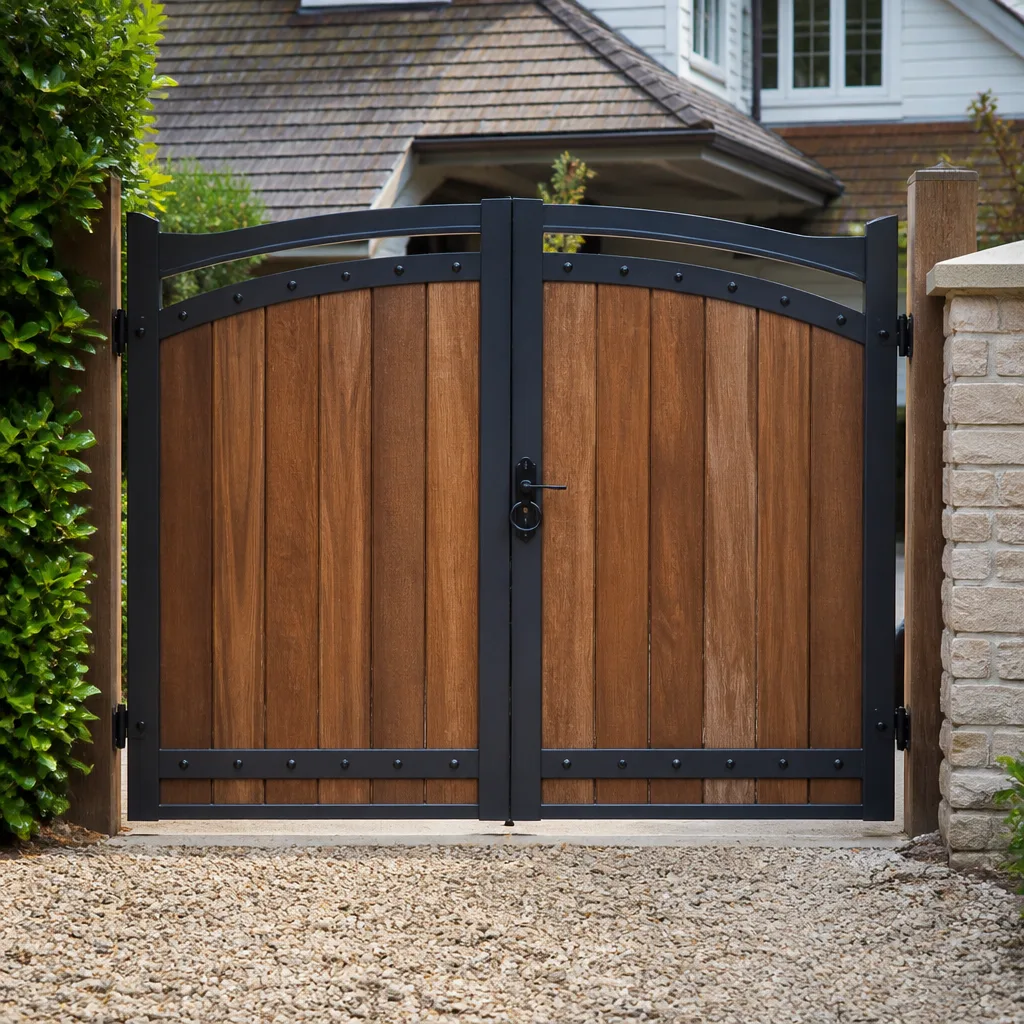 Wood & steel frame
 Farm & ranch
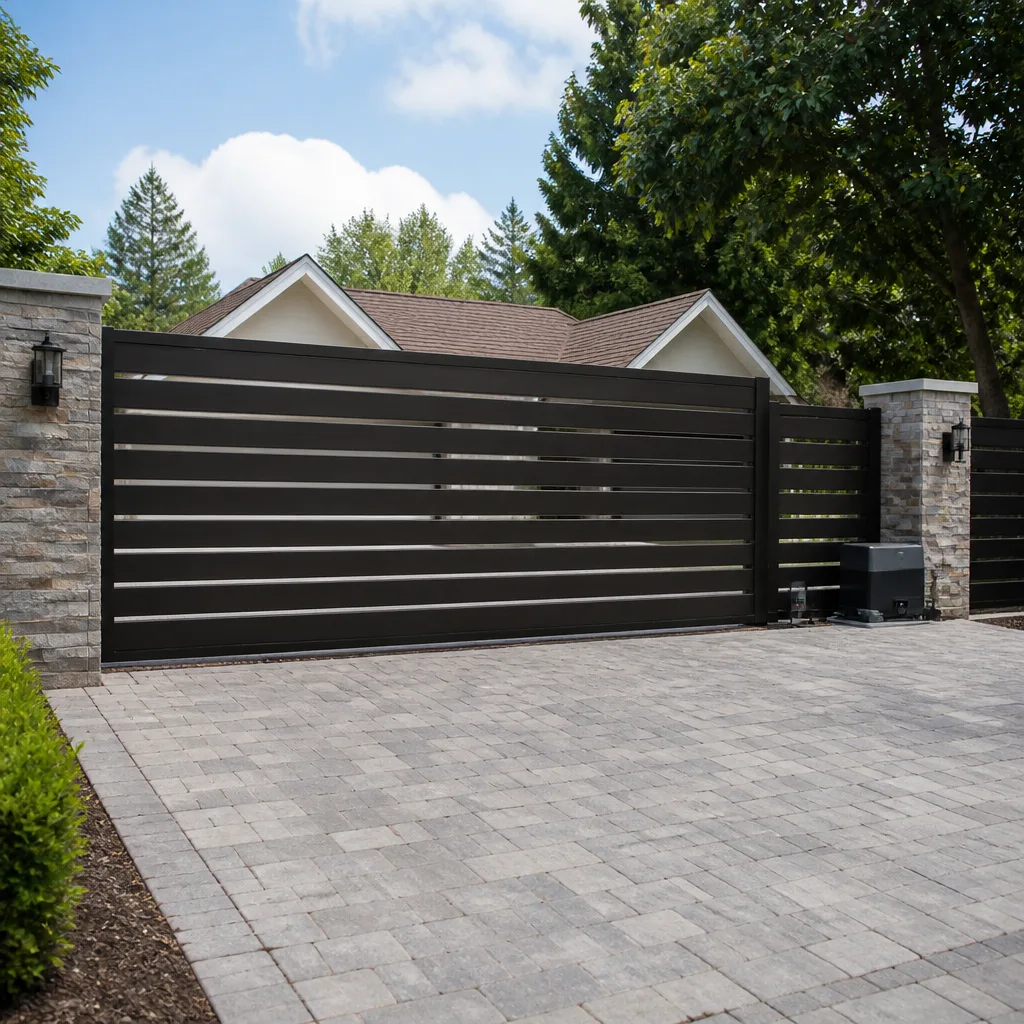 Sliding driveway gates
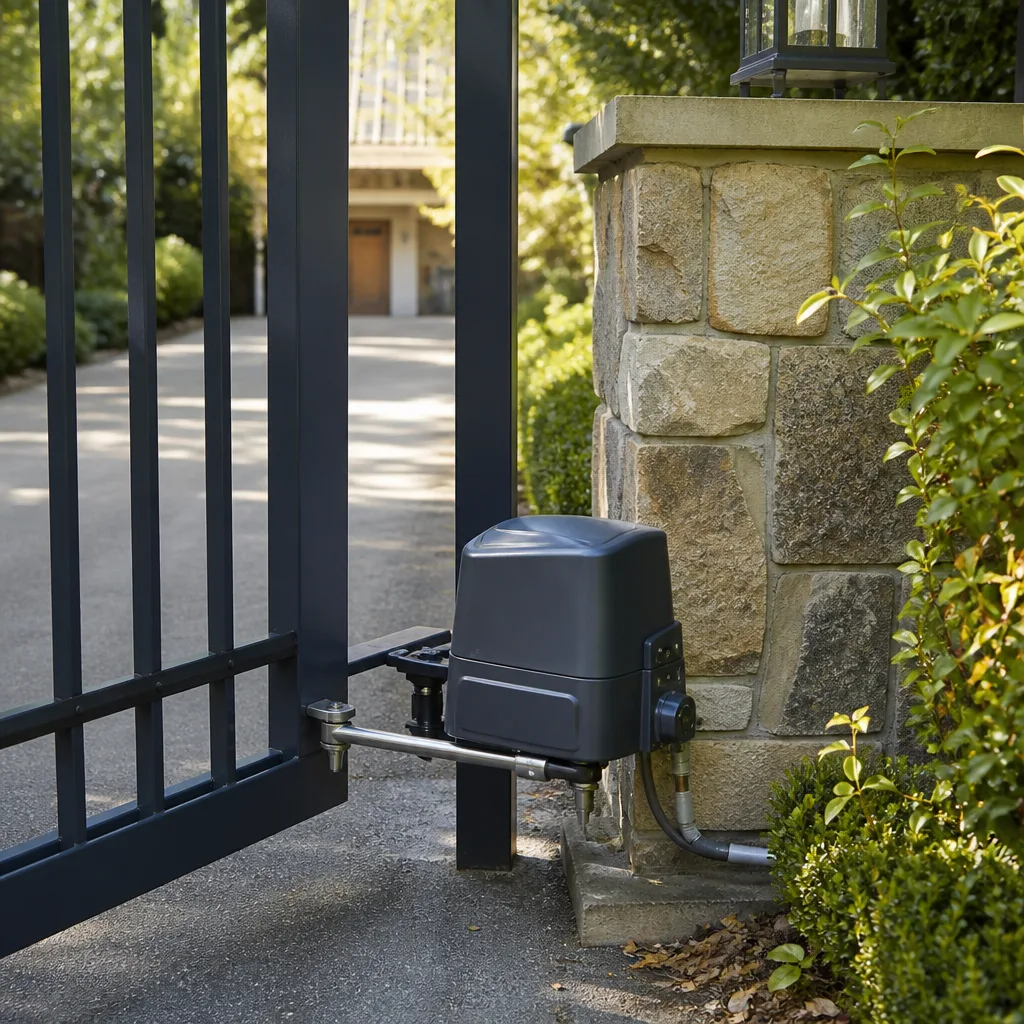 LiftMaster operators
Free on-site gate assessment - hinges, posts, and your LiftMaster or Nice gate operator checked before anything is quoted
The assessment is free and the quote is the invoice.
Get your free estimateGate Repair Maintenance Checklist for Mira Mesa Homeowners
Most gate failures in Mira Mesa don’t start with a loud bang. They start quietly, with dust packed into a control board or a chain running dry because someone sprayed it with the wrong product. Using WD-40 on a chain-drive gate operator is one of the most common maintenance mistakes in this region. It strips the lubricant already on the chain and accelerates wear within weeks. This guide is built around the hardware actually installed on Mira Mesa driveways and the real intervals that keep it running, not a generic checklist that treats every gate the same.
Styles & brands we work with
- Wrought iron
- Wood & steel frame
- Farm & ranch
- Sliding driveway gates
- LiftMaster operators
Quick Answer
A proper gate maintenance routine for Mira Mesa homeowners includes monthly visual inspections of hinges, chains, and safety sensors, lubrication every 3 to 6 months using a product matched to your operator type, and a thorough electrical check of the control board, battery backup, and limit switches twice a year. The single most important habit is logging what you observe, because most gate failures give warning signs weeks before they strand you outside your driveway.
Table of Contents
- Why Mira Mesa Gates Fail Differently
- Lubrication by Operator Type: What to Use and When
- The 15-Minute Monthly Walkthrough (No Tools Required)
- Seasonal Checks: Santa Ana Winds and Mesa-Top Sun
- The Three Checks Technicians Do First (That Homeowners Skip)
- Normal Wear on a 5-Year Gate vs. Early Warning Signs
- Commercial Gate Considerations for HOA and Property Managers
- Common Mistakes to Avoid
- When to Call a Professional
- Frequently Asked Questions
- The Bottom Line
Why Mira Mesa Gates Fail Differently
A gate in Mira Mesa lives a harder life than the same gate in, say, coastal La Jolla or even inland Rancho Bernardo. The reasons are specific to this mesa. First, the easterly Santa Ana winds that blow through in fall and early winter carry fine dust and grit. That dust doesn’t just sit on the gate’s surface. It gets pulled into control board enclosures by the cooling fans inside operator housings. Over time, a layer of dust builds up on circuit boards, holds heat, and creates the conditions for intermittent faults that are hard to diagnose without opening the box.
Second, Mira Mesa sits on an exposed mesa top. There’s very little tree canopy in most residential sections, which means gate operators, keypad housings, and wiring conduit take direct sun for hours every day. UV degradation on plastic conduit is real. We’ve opened junction boxes in Mira Mesa where the conduit had become so brittle it crumbled when touched, exposing low-voltage wiring to moisture and insects. That’s not a dramatic failure. It’s a slow one, and it’s preventable with a visual check.
Third, the soil here is dry and sandy in most yards. That matters for swing gates with ground-set posts. When the soil shifts slightly with wet-dry cycles, a gate that was perfectly level at installation can sag enough to change how the latch engages or how the limit switches read travel. None of this means Mira Mesa is a uniquely hostile place for gates. It means the maintenance routine should account for dust, sun, and soil movement, not just the mechanical parts.
If you’re looking for a detailed breakdown of what repair work typically involves in this neighborhood, our Gate Repair in Mira Mesa page walks through the common failure points we see. For now, the maintenance side is where most of this is headed off before it becomes a repair call.
Lubrication by Operator Type: What to Use and When
Lubrication is the single most misunderstood part of gate maintenance. The wrong product in the wrong place does more damage than no lubrication at all. Here’s the breakdown by operator type, because a chain-drive slide gate and a hydraulic swing gate have completely different needs.
Chain-Drive Slide Gates
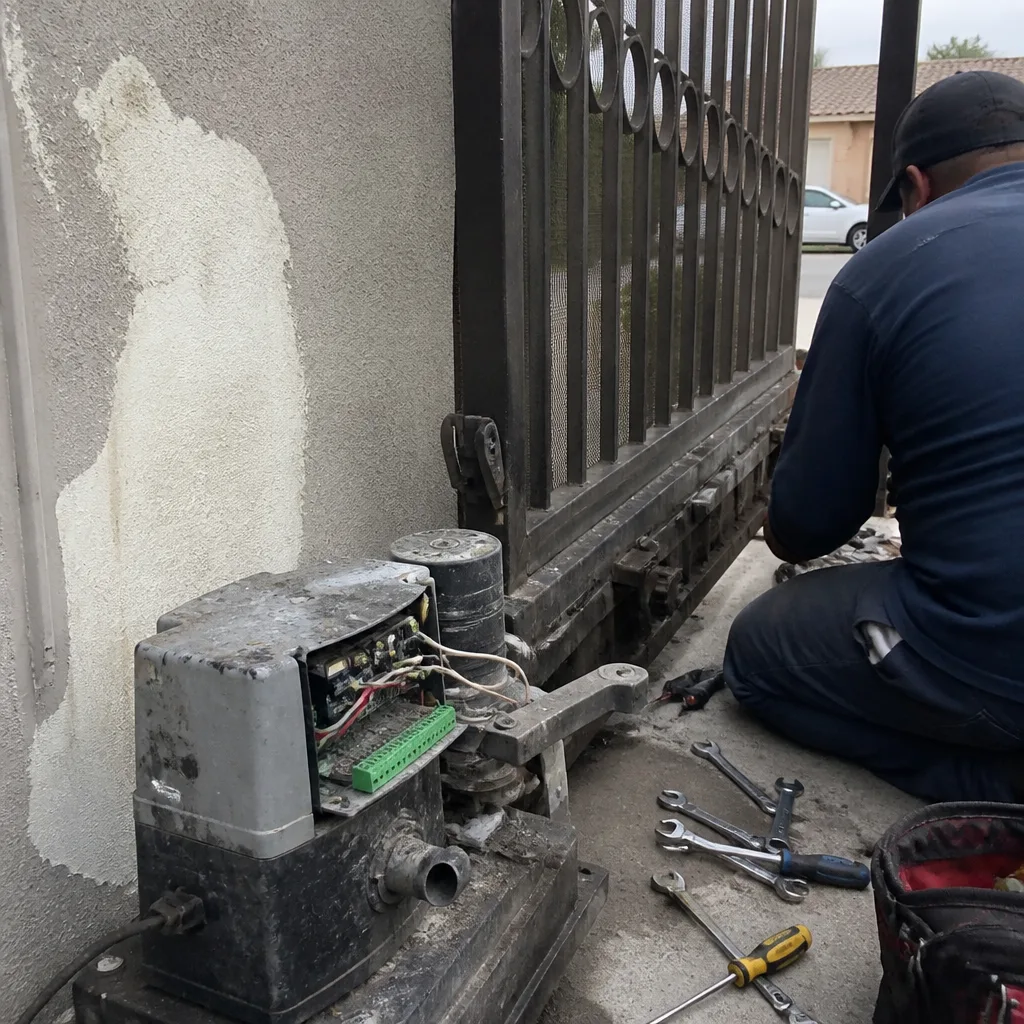
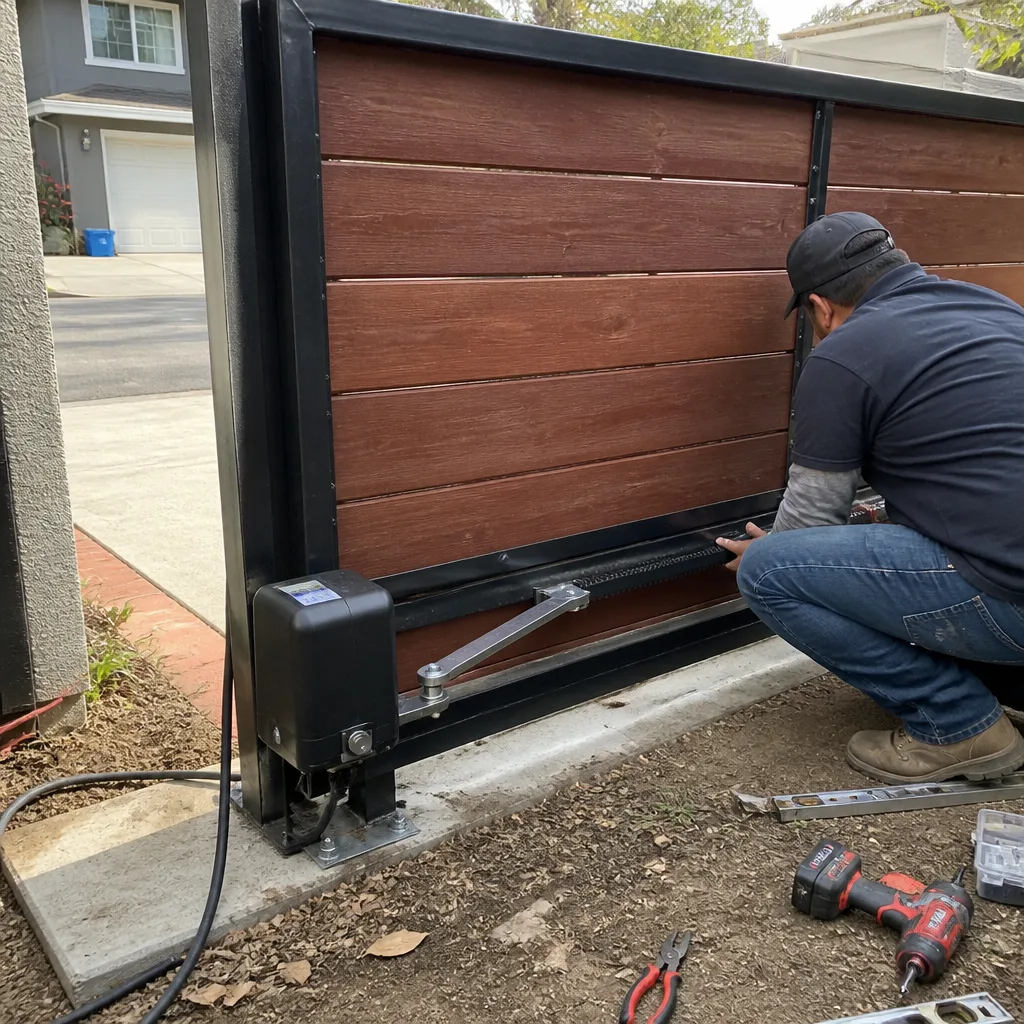
Chain-drive gates use a metal chain running along a rail, driven by a sprocket on the motor. These chains need a dry-film lubricant or a dedicated chain lube designed for open-air environments. In Mira Mesa’s dusty conditions, a wet, sticky lubricant is a problem because it attracts grit and turns into a grinding paste. Apply lubricant every 3 months. Before applying, wipe the chain down with a clean rag to remove old lubricant and dust. Then apply a thin, even coat while the gate moves slowly through a cycle. You want the chain to look damp, not dripping.
Rack-and-Pinion Slide Gates
Rack-and-pinion systems use a gear on the motor that drives a toothed rack along the gate. The contact point between gear teeth and rack teeth needs a light grease, not a spray lubricant. A lithium-based grease applied in a thin film every 4 to 6 months works well. Too much grease flings off and collects dust. Wipe the rack with a rag first, check for any chipped or missing teeth while you’re there, then apply a thin bead along the rack’s working length.
Hydraulic Swing Gate Operators
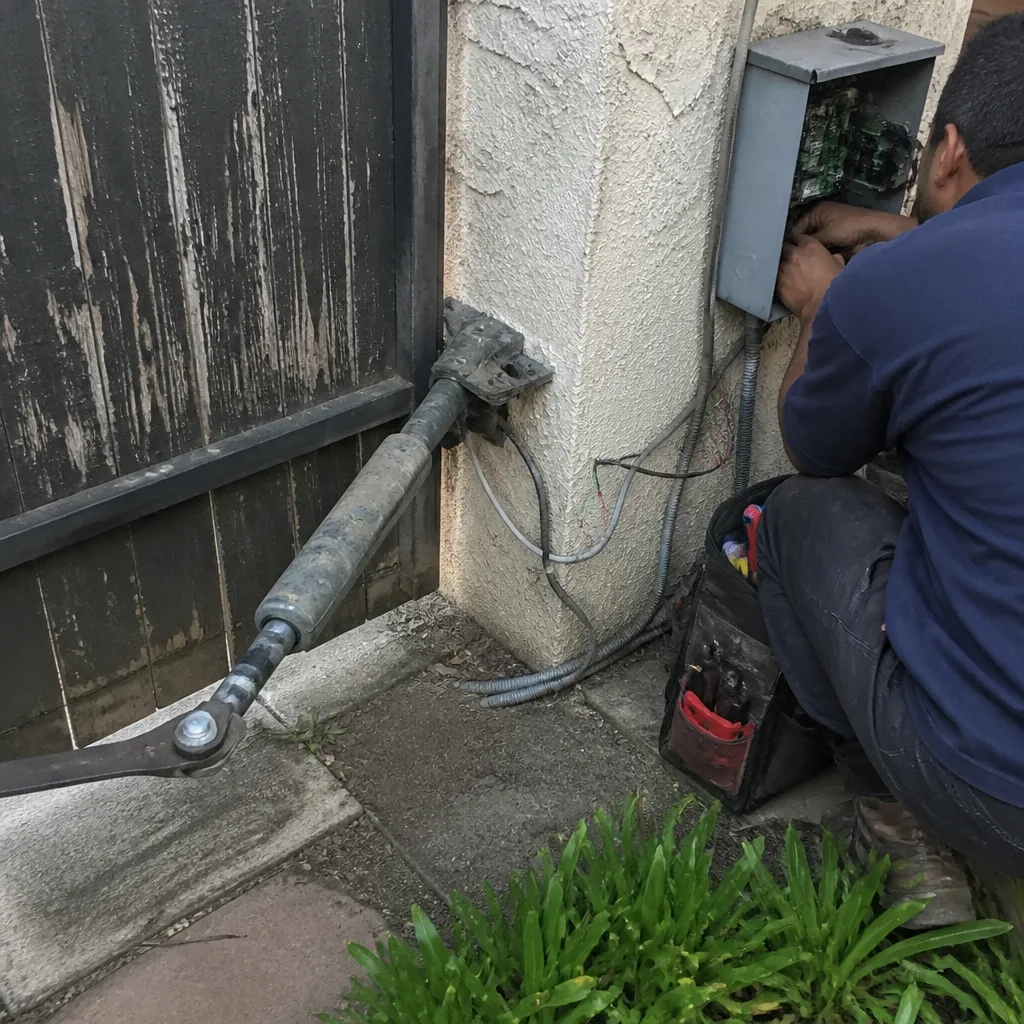
Hydraulic operators, common on heavier ornamental iron swing gates, use fluid pressure rather than a direct mechanical drive. The operator itself is sealed and generally doesn’t need internal lubrication, which is good, because opening one without proper training is a good way to ruin a $2,000+ unit. What does need attention on hydraulic systems is the gate’s pivot hinges and any mechanical arm connections. Use a heavy-duty grease on hinge pins every 6 months, and check the hydraulic fluid level and condition annually. Fluid that looks milky has moisture in it and needs to be addressed professionally. FAAC and BFT hydraulic units are both common in Mira Mesa’s newer developments, and both have specific fluid specs that matter more than homeowners expect.
General Hinge and Latch Lubrication
Regardless of operator type, every gate has hinges, and every gate with a latch has a latch mechanism. These need a silicone-based or white lithium grease spray every 3 months. The goal is to prevent metal-on-metal wear and reduce the load the operator has to overcome. A gate that’s hard to move manually is telling you something: the operator is working harder than it should, and that shortens its life.
The 15-Minute Monthly Walkthrough (No Tools Required)
This is the maintenance routine a Mira Mesa homeowner can realistically do every month without touching a wrench. It takes about 15 minutes. The point isn’t to fix anything. It’s to notice changes before they become failures.
- Stand at one end of the gate and look down its length. Is the top edge level? A visible sag on a swing gate or a tilt on a slide gate means something has shifted. Write it down.
- Run the gate through one full open and close cycle. Listen. A change in sound – new grinding, squealing, a rhythmic thump – is a warning sign. Note what you hear and where it seems to come from.
- Watch the gate’s speed through the cycle. Does it slow down in the same spot every time? Does it hesitate before reversing? That’s a sign of resistance or a limit switch issue.
- Check the safety sensors. Look at the photocells near the bottom of the gate track or posts. Are both lenses clean and aimed at each other? A quick wipe with a dry cloth is fine. Don’t adjust them – that’s a calibration task.
- Check for debris in the track or swing path. Mira Mesa yards produce leaves, palm fronds, and the occasional tumbleweed. Anything in the path makes the gate work harder.
- Look at exposed wiring and conduit. Is anything cracked, chewed, or hanging loose? Don’t touch wiring. Just note it.
- Open the control box cover if it’s accessible and safe to do so. A visual check for dust buildup, spider webs, or corrosion is fine. Don’t touch anything inside.
Where to stop and call a professional: if you see exposed copper wiring, hear a grinding you can localize to the motor housing, smell anything burning, or notice the gate reversing unexpectedly without obstruction, stop the walkthrough and call. None of those are DIY issues. This is where the line between maintenance and repair gets drawn. Our Gate Repair Mira Mesa home page explains what’s covered under repair service versus routine upkeep.
Seasonal Checks: Santa Ana Winds and Mesa-Top Sun
Mira Mesa’s climate isn’t dramatic, but it has two seasonal patterns that matter for gates. The Santa Ana wind season, typically September through November, brings the dust that settles into control boards and chain links. The summer months, July through September, bring intense UV exposure that degrades plastic components.
After Santa Ana Wind Events
After a strong wind event, do a 10-minute check. Blow or wipe dust off the control board housing exterior. Check that no fine dust has accumulated around the cooling vents on the operator. On chain-drive gates, run a finger along the chain. If it feels gritty rather than lightly oily, it’s time to clean and re-lubricate even if you’re not at the 3-month mark. Dust acts as an abrasive between chain links and sprockets.
Before Summer Heat Peaks
In late spring, inspect all exposed plastic: conduit, wire nuts, photocell housings, keypad enclosures. Look for fading, chalking, or hairline cracks. UV damage happens slowly, then all at once when a brittle conduit finally splits. If you catch cracking early, a professional can replace conduit sections before wiring is exposed to moisture or pests. This is also a good time to check the battery backup on gates that have one. Heat shortens battery life, and a battery that tests fine in January may be marginal by August. The test is simple: unplug or switch off AC power to the operator and run the gate. If it runs slowly or not at all, the battery needs replacement. If you’re not comfortable doing this, it’s a quick professional check.
For homeowners who want a deeper look at how electric gate systems function and what components matter, our Electric Gate Repair in Mira Mesa page covers motors, control boards, and safety systems in detail.
The Three Checks Technicians Do First (That Homeowners Skip)
When we arrive at a Mira Mesa gate that’s acting up, there are three things we check before anything else. These are quick, diagnostic checks that reveal most problems. Homeowners can learn to do them too, and they’re the highest-value items on any maintenance checklist. For deeper help, see our Gate Repair Troubleshooting: Common Problems and How to Fix Them.
1. Photocell Alignment
Photocells are the safety sensors that stop a gate from closing on a car, a child, or a dog. They work by sending an invisible beam from one side of the gate opening to the other. If the beam is broken or misaligned, the gate won’t close properly, or it will reverse mid-cycle. Photocells are mounted on brackets that get bumped by landscapers, kicked by kids, and shifted by gate vibration. Checking alignment means looking at the small LED indicators on each photocell. On most systems, a solid green light on the receiver means the beam is aligned. A blinking light means it’s not. The fix is usually a gentle bracket adjustment, but on a LiftMaster or Mighty Mule system with integrated diagnostics, the behavior varies. If you’re not sure what the lights mean on your specific unit, write down the light pattern and call a professional rather than guessing.
2. Battery Backup Voltage
Many Mira Mesa gates, especially in neighborhoods where power interruptions happen during Santa Ana events, have battery backup systems. These batteries are sealed lead-acid units that degrade over 3 to 5 years. A simple voltage test with a multimeter tells you a lot. A healthy 12-volt battery should read between 12.6 and 13.8 volts when fully charged. A reading below 12.0 volts under load means the battery is nearing the end of its life. If you don’t own a multimeter and don’t want to buy one, the operational test I described earlier – cutting AC power and running the gate – gives you a practical answer. The professional service here isn’t just replacing the battery. It’s also checking whether the charging circuit on the control board is working properly, because a failed charger will kill a new battery in months.
3. Limit Switch Positions
Limit switches tell the operator exactly where the gate should stop at the open and closed positions. When they drift or fail, the gate either bangs hard against the stops at each end of travel or doesn’t close fully, leaving a gap. On a slide gate, limit adjustment is mechanical and requires opening the operator cover. On a swing gate with a linear arm operator, the limits are often set electronically through the control board. Checking limit switches as a homeowner starts with observation: does the gate stop smoothly at the same point every time, or does it slam? Does it stop short of fully closed? If the gate’s behavior changes, don’t start adjusting limit switches yourself. You can easily over-travel the gate and damage the operator. Document the behavior. A professional can correct limit positions in minutes with the right tools and without risking the motor.
These three checks catch the majority of issues that eventually turn into “my gate won’t open” calls. They also form the core of a professional maintenance visit, which is worth scheduling annually even if everything seems fine. We work on the brand already on your property, so a maintenance visit doesn’t hinge on whether we sold the operator.
Normal Wear on a 5-Year Gate vs. Early Warning Signs
Every gate wears. The question is whether what you’re seeing is normal for the age of the system or a sign that something’s about to fail. Here’s what a 5-year-old gate in Mira Mesa should look like, and what it shouldn’t.
What’s Normal at Year 5
- Chain stretch on a slide gate: Chains develop slight slack over years of cycles. If the chain has a visible sag but the gate still runs smoothly and stops accurately, that’s normal wear. It’s worth having the tension checked at your annual maintenance.
- Cosmetic rust on welds or hardware: In a dry climate like Mira Mesa, surface rust on exposed steel is cosmetic. It’s not a structural concern if it’s chased and painted. What’s more concerning is rust on electrical connections inside the control box, which indicates moisture ingress.
- Photocell sensitivity drift: After 5 years, photocells may need cleaning more often, and their brackets may need occasional re-aiming. That’s fine. The lens itself shouldn’t be cracked or fogged.
- Keypad button wear: If the numbers on a mechanical keypad are worn smooth, that’s expected with daily use. If the keypad stops responding to certain numbers, that’s an electrical issue.
Early Warning Signs That Need Attention
- A gate that slows noticeably mid-cycle: This often indicates increased mechanical resistance or a motor that’s starting to work outside its normal range. Ignore it and you’ll eventually burn out the motor or strip a gear.
- Intermittent failure to respond to remotes or keypads: If the gate works fine most days but occasionally ignores commands, you have an electrical issue – a failing capacitor, a loose connection, a control board starting to degrade. Intermittent problems get worse, never better.
- Visible sparks or a burning smell near the operator: This is an emergency. Cut power to the operator at the breaker if you can do so safely, and call a professional immediately.
- A change in closing force: If the gate used to close softly and now bangs into the stop, the limit or force settings have drifted. Continued operation in this state will damage the operator and possibly the gate structure.
- Rust streaks coming from inside the control box or operator housing: Internal rust means water is getting in somewhere. That’s a fix-now issue, because water plus a powered control board equals a short, and a short can destroy the board entirely.
One brand-specific note: Mighty Mule and Ghost Controls units are popular on residential gates in Mira Mesa because they’re accessible and relatively affordable. They’re also more sensitive to voltage fluctuations than heavier commercial units like FAAC or BFT. If you have a Mighty Mule system and it starts acting erratically after a power outage, check the battery and the low-voltage transformer before assuming the control board is dead. The problem is often upstream of the board.
Commercial Gate Considerations for HOA and Property Managers
If you manage a commercial property in Mira Mesa – a parking lot gate, an HOA entry, a business driveway – the maintenance stakes are different. A failed residential gate annoys one family. A failed commercial gate blocks tenants, delivery trucks, emergency vehicles, and daily traffic. Commercial operators run more cycles per day than residential units, sometimes 10 to 50 times more. That changes the maintenance math significantly.
Commercial slide gates with rack-and-pinion drives, such as DoorKing and LiftMaster commercial units, need rack lubrication more frequently than the 4 to 6 month residential interval. On a busy lot, check the rack every 2 months. Commercial swing gates with FAAC or BFT hydraulic operators should have hydraulic fluid inspected quarterly, not annually. The wear on a commercial gate is roughly proportional to cycle count, and a maintenance schedule that works for a residential driveway doesn’t transfer to a 24-7 access point.
There’s also a safety layer. Commercial automatic gates in California fall under UL 325 and ASTM F2200 safety standards, which require working safety devices – photocells, edge sensors, or both – in place and functional. A gate that operates without functioning safety sensors isn’t just a maintenance problem. It’s a liability. Property managers should keep a maintenance log that documents safety device testing, and they should have a professional inspect the system at least twice a year. Gate repair is all we do, so commercial maintenance visits cover the mechanical, electrical, and safety compliance side of the system in one pass.
For a full picture of what gate installation involves, whether you’re planning a new commercial access point or replacing an aging residential gate, see our Gate Installation in Mira Mesa page.
Common Mistakes to Avoid
- Using WD-40 or a generic penetrating spray on gate chains. These products are designed to break up rust and displace moisture, not to lubricate moving parts under load. They strip existing lubricant and leave the chain more exposed to wear. Use a dry-film chain lubricant instead.
- Ignoring a gate that works “most of the time.” Intermittent problems are diagnostic gold. A gate that fails 2% of the time will fail 100% of the time at the worst possible moment. Document intermittent behavior and get it checked.
- Adjusting limit switches or force settings without understanding the system. Force and limit adjustments are the most common way homeowners turn a $200 repair into a $2,000 motor replacement. A gate that slams into its stop is trying to tell you something. Listen, and call someone who knows what the adjustment range should be.
- Hosing down the gate or operator area during regular yard work. Water is the enemy of electrical components. Pressure washing near the operator housing, the control box, or the photocells can force water into sealed enclosures. Rinse with a gentle hose stream if needed, and never aim directly at electrical housings.
- Waiting until the gate stops moving to address a noise change. By the time a grinding noise turns into a seized gate, the damage has usually spread from one component to the drivetrain. A $75 chain tension adjustment beats a $500 gear replacement. We carry components for the systems most technicians have to special-order, so a small problem doesn’t have to become a big one.
- Treating battery replacement as optional. On a gate with battery backup, a dead battery doesn’t just mean the gate won’t open during a power outage. A sulfated battery can also damage the charging circuit on the control board. Replace batteries every 3 to 5 years, whether or not they’ve caused problems yet.
When to Call a Professional
There’s a clear line between the maintenance tasks a homeowner can safely handle and the diagnostics and repairs that require training. Call a professional when you see exposed wiring, when the gate makes a grinding noise that seems to come from inside the motor housing, when safety sensors won’t respond to cleaning and basic alignment, when the gate reverses unexpectedly without a visible obstruction, or when a control board shows visible scorching, corrosion, or water damage. High-tension springs and powered operators carry enough force to cause serious injury if mishandled. A trained technician can identify the fault quickly and safely, and in many cases, the repair is smaller than the homeowner expects. For details on permits and legal requirements, read Gate Repair Permits, Codes & Inspections in CA: What You Need to Know. Gate Repair Mira Mesa offers free estimates in Mira Mesa – call (833) 593-4660.
Frequently Asked Questions
Lubricate chain-drive slide gates every 3 months, rack-and-pinion systems every 4 to 6 months with lithium grease, and swing gate hinges every 3 to 6 months. Mira Mesa’s dusty Santa Ana season may mean adding a cleaning and re-lubrication after major wind events. Call (833) 593-4660 for a maintenance schedule matched to your specific operator.
A dry-film chain lubricant designed for open-air environments is the best choice for gate chains. It coats the chain without attracting the dust and grit common in Mira Mesa. Avoid WD-40 and similar penetrating sprays, which strip existing lubrication. If you’re unsure what’s on your chain now, a professional can clean and re-lubricate it correctly.
You can handle monthly visual inspections, cleaning of photocells, basic lubrication, and seasonal checks of conduit and wiring condition. Leave electrical diagnostics, limit switch adjustments, spring work, and any repair involving the operator internals to a professional. The safety risk and the cost of a mistake both rise sharply once you’re opening control boxes or adjusting settings.
Intermittent operation usually points to an electrical issue: a failing capacitor, a loose connection, a control board beginning to degrade, or a low-voltage transformer that’s no longer delivering consistent power. These problems don’t fix themselves. Document when the gate fails and what the conditions were, then call for a diagnostic. The fault is often small when caught early.
Gate backup batteries typically last 3 to 5 years, but Mira Mesa’s summer heat can shorten that to 3 years on exposed installations. Test your battery by cutting AC power and running the gate. If it runs slowly or not at all, the battery is due for replacement. A failed battery can also damage the control board’s charging circuit, so don’t delay replacement.
A grinding noise means two surfaces are making contact under load when they shouldn’t be. It could be a chain running dry, a gear mesh issue in a rack-and-pinion system, or a motor bearing starting to fail. Stop using the gate and call for a diagnostic. Continued operation will spread the damage from one component to the drivetrain. Estimates are free.
The Bottom Line
A Mira Mesa gate lives or dies by the maintenance routine that matches its specific hardware and this neighborhood’s conditions. Chain-drive gates need dry-film lubrication on a 3-month schedule. Rack-and-pinion systems need lithium grease and rack inspections. Hydraulic swing gates need hinge grease and annual fluid checks. The monthly walkthrough is your highest-value habit: 15 minutes, no tools, and it catches most problems while they’re still cheap to fix. When you see something that doesn’t look right, don’t tune it out. Call (833) 593-4660. Gate Repair Mira Mesa works on the gate already on your property, and we’ve seen every brand installed on these driveways. A free estimate costs nothing, and a caught-early repair costs a fraction of an emergency service call.
Written by the team at Gate Repair Mira Mesa, serving Mira Mesa since 2017.
See the difference
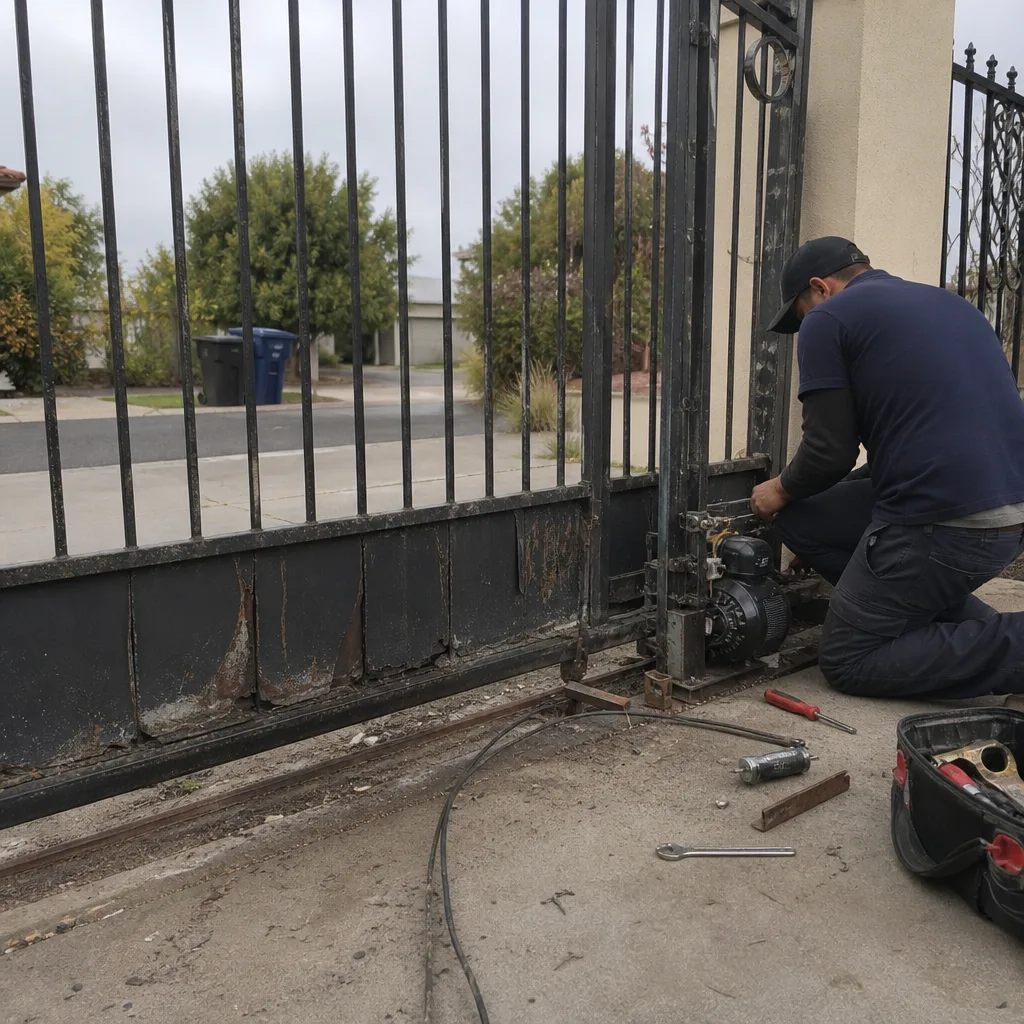 Before
 After
 Before
 After
 Before
 After